
Museum follows the beat of its mission
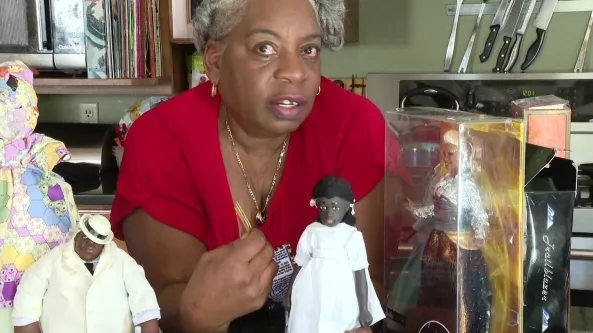
When Debra Britt and her sisters started the “Doll E Daze Project” in the early 2000s, they never guessed where their path would take them.
When speaking to Debra Britt on the phone, one is immediately struck by her warmth, friendliness, and generosity of spirit. Despite my own reservations about speaking to strangers, Debra immediately puts me at ease by her kindhearted and extroverted nature. I get the sense that’s simply who she is, a key reason why she is so passionate about building community.
As director of the National Black Doll Museum of History and Culture, Debra has long used dolls as the medium for her message. Starting with Doll E Daze in 2004, Debra and her sisters used to attend annual events where they used Black dolls to reach out to the community through workshops. They visited libraries, homeless shelters, and schools, using the dolls to, as Debra puts it, “teach people to live as one.”
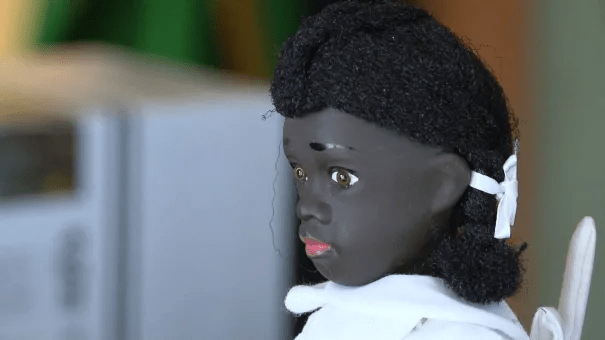
After all, Debra sees her mission in life is to reduce bullying by showing, teaching, and reminding everyone, especially children, of our common humanity. It’s a personal mission that’s reflected in the Museum’s organizational mission, which is threefold: first, to nurture self-esteem; second, to promote cultural diversity; and third, to preserve history, especially Black History.
Debra and her sisters quickly realized that the Doll E Daze, a popular and much-needed program, was much “more than just a workshop,” Debra says. “It was overwhelming. There was too much demand” on Debra and her sisters, who needed a central location that would serve both as a base of operations as well as a place where people could learn beyond the boundaries of a workshop.
As a result, they planned, prayed, and finally were able to open a non-profit museum in 2012, situated in downtown Mansfield, Mass. According to their website, the Museum has over 7,000 dolls in its collection, making it the second largest such collection in the United States, and the only one in the South Coast region.
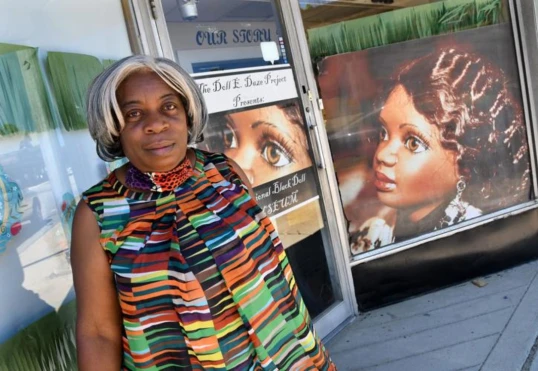
Sadly, however, the ravages of the COVID-19 pandemic touched the Museum, a true loss as the Museum was the only one of its kind. The closures of schools and other locations meant a loss of the revenue the Museum depended upon to survive, and as a result, the Museum was forced to suddenly close its physical location in June of 2020. The speed at which the Museum had to vacate means that, at present, much of the collection has been stored in unmarked boxes.
After eight years of serving the region, the Museum had to go virtual. However, Debra sees this as a blessing in disguise; with online events, they are now able to hold online workshops “all across the country,” according to Debra, expanding the Museum’s reach far beyond Massachusetts’ borders. Teachers and organizations are able to book workshops through the Museum’s website; Debra puts together doll-making kits and sends them out. During the workshop itself, Debra connects with children, instructing them how to use the kits to create their own dolls and including a healthy dose of gentle encouragement at the same time.
Nobody deserves to be treated inhumanely.
Debra Britt
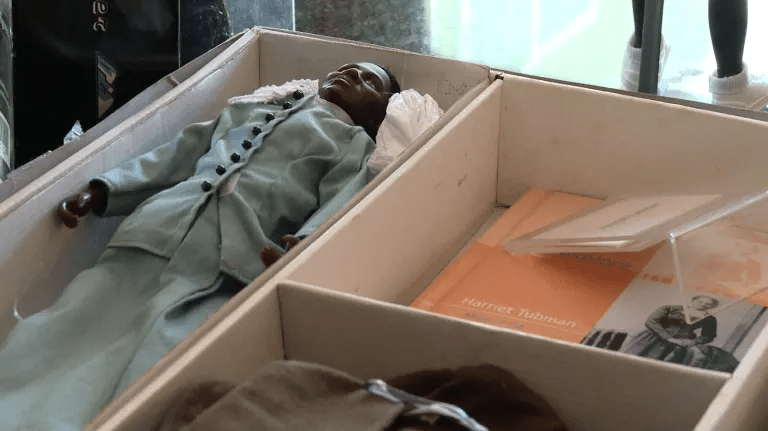
Debra teaches them, as she says, to put “all their fear inside their dolls,” as she often works with children who have suffered and seen too much in their short lives. While they work, she teaches them about Black history, using handmade dolls of often-forgotten Black heroes as illustration, talks to them about the value of trying, failing, and trying again, and encourages children to find their passion. As a child, Debra herself suffered from bullying, which is why she is so passionate about the Museum’s mission. “Nobody deserves to be treated inhumanely,” she says, a lesson that’s needed now more than ever.
Looking forward, Debra envisions a purpose-built space for the Museum; she’s working towards relocating the Museum in Attleboro, Mass, in a building that will have room to house the collection, ensure that the dolls are correctly stored and preserved for future generations, and help develop further educational resources that advance the Museum’s mission.
Want to help? There is a LaunchGood campaign running, where anyone can help contribute to the Museum’s new home. In addition to the campaign, Debra hopes to hold an event, to be held after the Juneteenth celebration, where volunteers can come help sort and organize the Museum’s collection. To learn more, visit the Museum’s website at www.nbdmhc.org, email info@ndbmch.org, or call 774-284-4729.

 Barbara Shaddix