
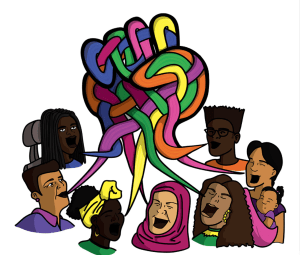
These days, being a radical feminist carries its own baggage, above and beyond the ancient canard of being “man haters.” Who wants to be associated with TERFs and their ilk, after all? – who, in the opinion of this radical feminist, at any rate, have utterly abandoned the principles of radical feminism and who have lost the moral justification to be known as such.
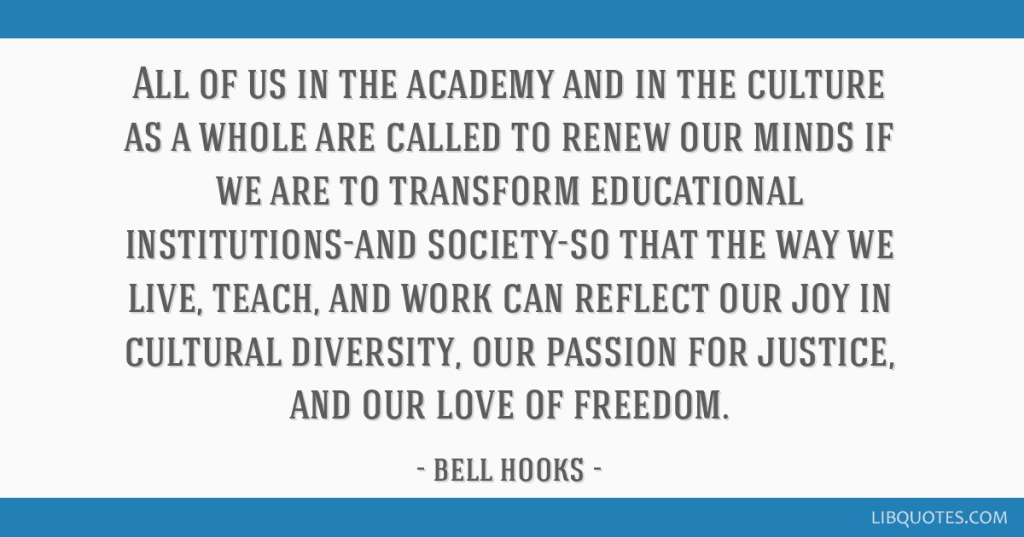
Why is that? Radical feminism is all about inclusion – being who you are, being accepted for who you are, exactly as you are – up to and including individuals who reject the patriarchal gender norms that insist that biological determinism is the only acceptable interpretation of gender. In the classroom, therefore, to teach like radical feminists means to structure the classroom around inclusivity, as pointed out by bell hooks (quoted by Jessica Edward in “Inclusive Practices in the Technical Communication Classroom”):
…any radical pedagogy must insist that everyone’s presence is acknowledged. That insistence cannot be simply stated. It has to be demonstrated through pedagogical practices.
How, then, to put this into practice? How do we move from the theory of inclusive pedagogy to the practice of inclusive pedagogy? How, in other words, do we become good radical fems, faithful to that principle of accepting others for who they are?
I suspect that this shift in the classroom means to completely reimagine what is meant by teachers, students, and the interior structure of the classroom. As I type this, I sit at an elevated desk in front of a room full of students all busily working on their justification memos – and I’ve made it a condition of their release from the classroom to show me their rough draft before they go. Is this patriarchy at work? Or some sort of matriarchy (my goal, after all, is to mother them along to the degree allowable within our university system)? It seems far away from bell hooks’ ideas of a “radical pedagogy,” and I still have much work to do in this regard.
According to April Baker-Bell, in her book Linguistic Justice, she uses “the term White Mainstream English in place of standard English to emphasize how white ways of speaking become the invisible—or better, inaudible—norm” (5). Likewise, I choose to continue the use of this term to describe the so-called “standard English” norms that are largely utilized in the Business classroom as the “professional” way of speaking and writing. There is a clear correlation between what’s considered acceptable writing in the business setting, after all, and which group has vast amounts of boardroom power.
Within the classroom, where I am bound by both cultural and institutional expectations of behavior and modalities, I teach Business Communication through the principles of narrative. Your stories are your own, I tell my students; my job is to help you develop your own voice so that your stories ring loud, clear, and true to you. We are story-making, story-telling creatures who filter our experiences through narratives, whether that be a grand, overarching tale that encompasses all that we know, or the single small story that goes into developing a persuasive Twitter post. For me, to the degree that I can help my students write in a voice that is all their own, unfettered by the conventions of White Mainstream English, teaching them to write as themselves is the beginning of the necessary work to dismantle centuries of linguistic oppression. This does mean, to be sure, that although I teach the “standard” modes of English as dictated by the curriculum, I only address grammar while grading as a function of rhetorical clarity.
I hope that by doing these and other moves in the classroom, I’m helping to build the inclusive classroom I want to teach in. Without a doubt, there is more I could and should be doing; the work is never done.

 Barbara Shaddix